
Design Guides
Choosing the Right Cabinets: Stock, Semi-Custom, and Custom (2026)
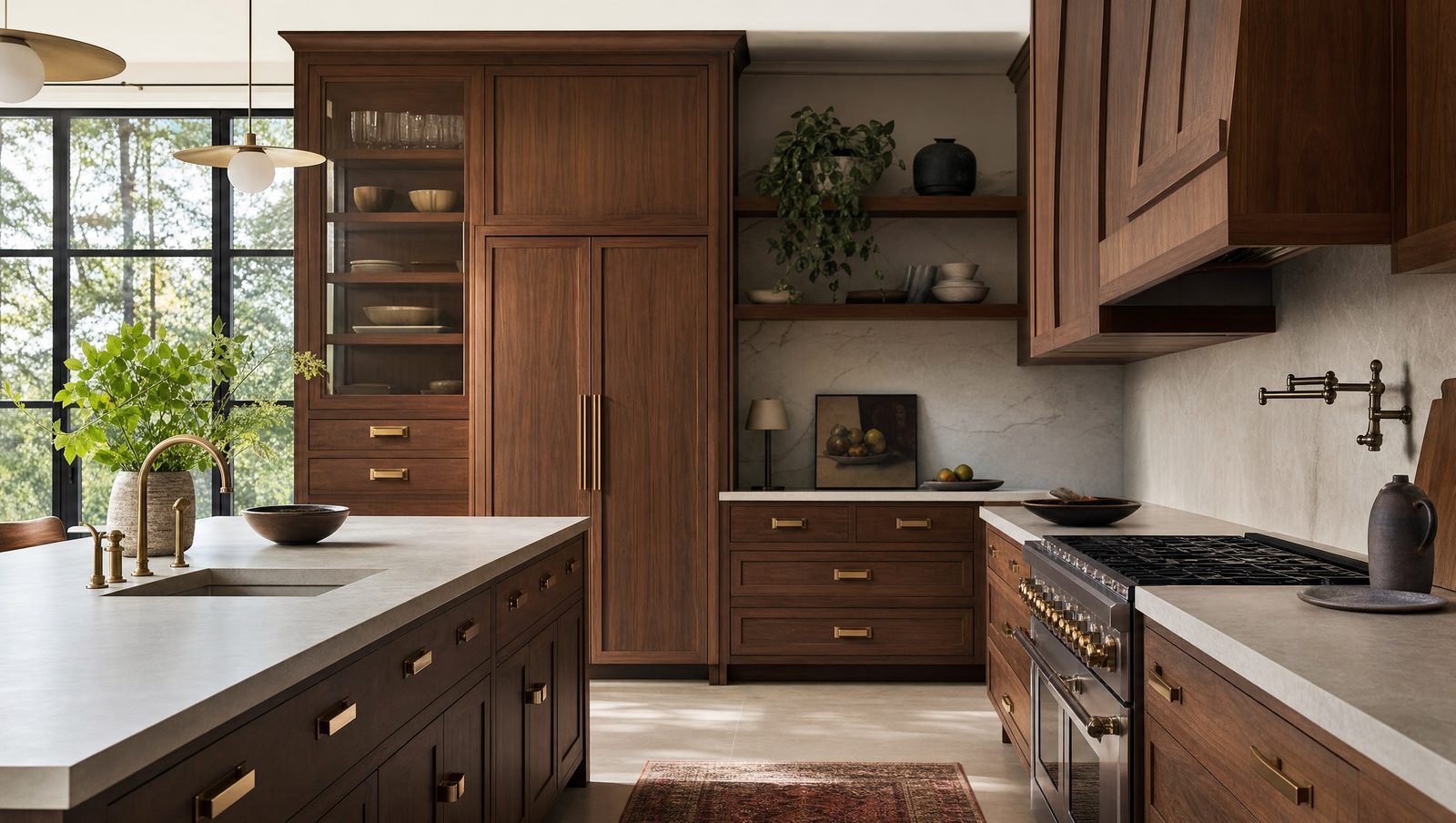
Every kitchen conversation eventually lands on the same question: stock, semi-custom, or custom? The three aren't really tiers of the same product — they're different ways of building a kitchen, with different tradeoffs in fit, construction, and timeline. Here's the honest breakdown of each.
What is the actual difference between the three tiers?
Stock cabinets are pre-built, factory-made models sold in fixed dimensions with no flexibility in size or finish (Deslaurier, 2026). Semi-custom cabinets come in standard sizes but allow resizing and modification of finish, color, hardware, and layout (Angi, 2026). Custom cabinets are built to your exact specifications — every dimension, material, and detail chosen from scratch (Kitchen Cabinet Guys, 2026).
The distinction is really about where the flexibility lives. Stock has none. Semi-custom flexes within a standard box. Custom starts with your space, not a catalog size.
| Feature | Stock | Semi-Custom | Custom |
|---|---|---|---|
| Sizing | Fixed dimensions | Standard sizes, resizable | Built to exact space |
| Construction | Particleboard | Plywood | Solid wood, dovetail joinery |
| Lead time | Days to weeks | Faster than custom | Up to 9+ weeks |
| Personalization | Minimal | Finish, hardware, layout | Everything |
| Relative cost | Lowest | Moderate | Highest |
Source: Deslaurier, Angi, Ayr Cabinet & Kitchen Cabinet Guys, 2026.
How does construction quality actually differ?
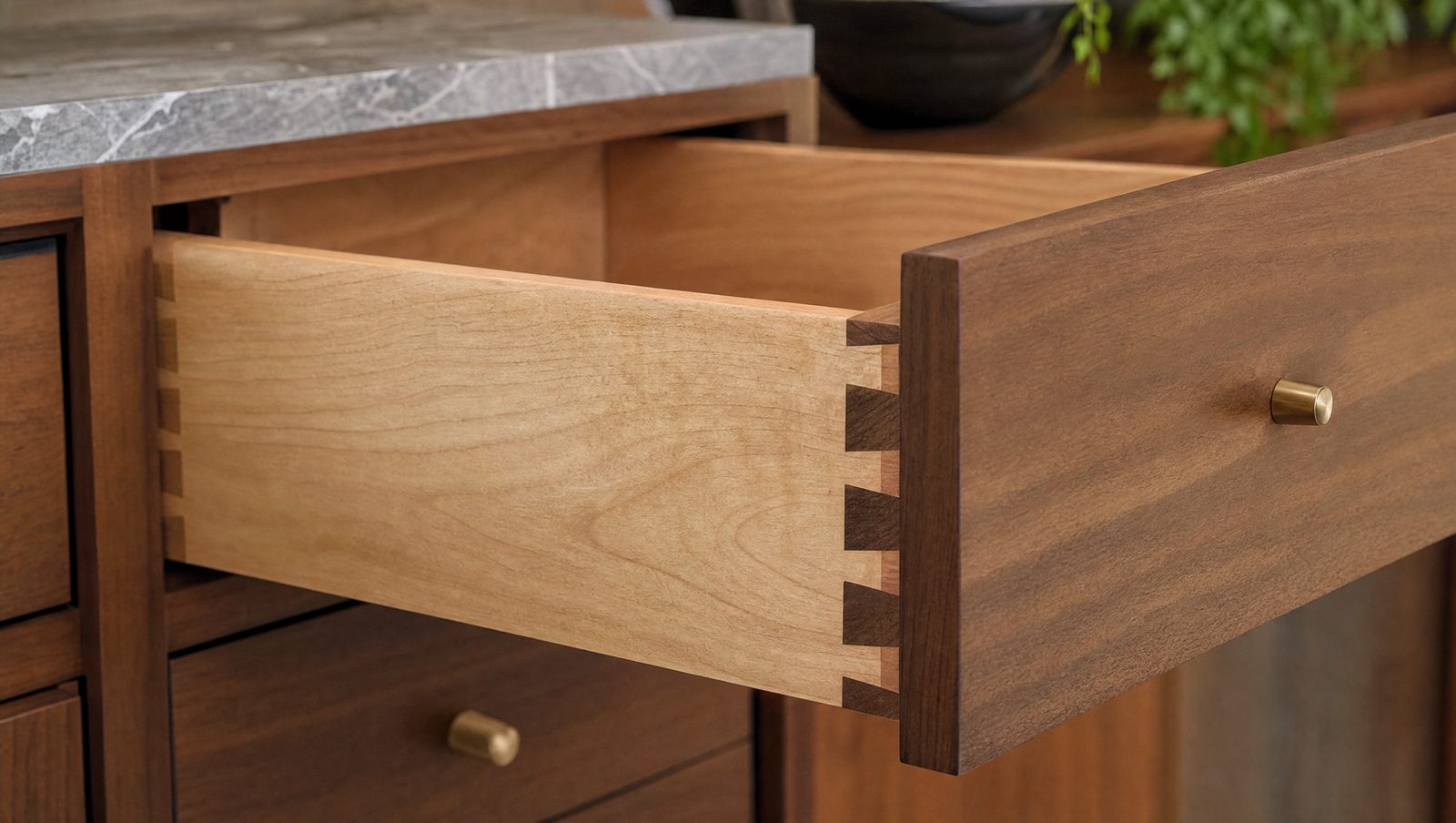
Stock cabinetry typically uses particleboard, semi-custom steps up to plywood construction, and custom cabinetry features solid wood with premium craftsmanship — dovetail joinery and hand-applied finishes (Ayr Cabinet, 2026). Semi-custom is usually factory-manufactured, while custom is handcrafted piece by piece for each specific project.
This is the part a photo can't show you. Two cabinets can look identical in a showroom and behave completely differently after five years of daily use — the difference lives in the box, not the door.
Our finding: clients almost always focus on the door style first and the box construction last, when it should be the other way around. A beautiful door on a particleboard box is a five-year kitchen. A plain door on a solid-wood, dovetailed box is a twenty-year kitchen you can always refinish or re-face.
How long does each option take to get?
Stock cabinets are mass-produced and ship fast — installed in days to weeks (Deslaurier, 2026). Semi-custom generally turns around faster than fully custom work. Custom cabinets, built to order, can take nine weeks or more for in-home delivery (Kitchen Cabinet Guys, 2026).
That timeline isn't a drawback so much as a planning input. If your renovation has a hard deadline, build the cabinet lead time into the schedule from day one — it's usually the longest single lead time in the whole project.
When does stock or semi-custom actually make sense?
Stock is the right call when the budget is the primary constraint and your space matches standard dimensions — a rental unit, a starter home, or a quick refresh where perfect fit isn't the priority. Semi-custom is the practical middle: a wider range of styles and finishes, a moderate budget, and construction quality that's a real step up from stock (Angi, 2026).
Neither is a lesser choice for the right project. The mismatch happens when someone with an awkward layout or a long-term home tries to force a standard box to fit — that's when semi-custom's resizing limits start to show.
When is custom worth the wait and the investment?
Custom earns its place when the layout is anything but standard, or when the kitchen is meant to last decades rather than years. Because every dimension is built to your actual space, custom cabinetry eliminates the filler panels and awkward gaps that stock and semi-custom units need when a wall, corner, or appliance doesn't match a catalog size.
It's also the only tier where construction quality is fully in your control — the wood species, the joinery, the finish, all chosen rather than selected from a limited range. For a kitchen you plan to live with for a long time, that control compounds. See our guide to Shaker vs. raised panel cabinets for how door style factors into that same decision.
How do you decide which one is right for your kitchen?
Start with your layout, not your budget. If your walls, corners, and appliance locations match standard dimensions, stock or semi-custom will serve you well and save real time. If your space is irregular, or you're building a kitchen meant to be the centerpiece of the home, custom removes the compromises the other two tiers require.
Then weigh the timeline. Custom's longer lead time is only a problem if it's not planned for — build it into your renovation schedule early, and it stops being a constraint.
Frequently asked questions
What is the difference between semi-custom and custom cabinets?
Semi-custom cabinets start from standard factory sizes with some flexibility in finish, hardware, and layout, while custom cabinets are built entirely to your specifications from scratch (Angi, 2026). Semi-custom also typically has a shorter lead time.
Are custom cabinets worth the extra wait?
For an irregular layout or a long-term home, yes — custom eliminates the filler panels and compromises that standard-size cabinets require, and gives full control over materials and joinery (Kitchen Cabinet Guys, 2026).
How long do custom cabinets take to arrive?
Custom cabinets can take nine weeks or more for in-home delivery, since they are built to order rather than pulled from stock (Kitchen Cabinet Guys, 2026). Build that lead time into your renovation schedule early.
What material are stock cabinets usually made from?
Stock cabinets typically use particleboard construction, while semi-custom steps up to plywood and custom often uses solid wood with dovetail joinery (Ayr Cabinet, 2026).
Is semi-custom a good compromise between stock and custom?
Often, yes — semi-custom offers more style and finish options than stock with meaningfully better construction, at a shorter lead time than fully custom cabinetry (Angi, 2026). It works well when your layout is close to standard dimensions.
The bottom line
Stock, semi-custom, and custom aren't good, better, best — they're three different answers to how much your layout and timeline matter. Stock and semi-custom serve standard spaces well and quickly. Custom earns its investment and its wait when the layout is irregular or the kitchen is meant to last. Know your layout and your timeline first, and the right tier becomes clear.
Book a design consultation and we'll help you choose the cabinetry that's actually right for your space.
Sources
- Deslaurier, Stock vs. Custom vs. Semi-Custom Cabinetry: What's the Difference?, retrieved 2026-07-24, link
- Angi, Custom vs. Semi-Custom Cabinets, retrieved 2026-07-24, link
- Kitchen Cabinet Guys, Custom vs. Stock Cabinets: Pros, Cons & Cost Comparison Guide, retrieved 2026-07-24, link
- Ayr Cabinet, 2026 Custom Cabinets Vs. Semi-Custom Cabinets, retrieved 2026-07-24, link